
Part of the Buying Journey Vendors Cannot See or Track
Modern B2B marketing has become heavily focused on visibility and discovery, helping companies get found before competitors and convert buyers once they are ready to act.
But the most consequential part of the buying journey often happens in the middle, where buyers research, compare vendors, assess risk, build internal consensus, and decide who belongs on their shortlist.
This middle layer is what some call the B2B Dark Funnel. Unlike the process of getting found or getting chosen, it cannot be fully automated, engineered, or tracked by software because it is shaped by human judgment, proof, and the independent research buyers do before they make themselves known to anyone.
Whether a buyer considers you for their shortlist during that phase comes down to how credible, visible, and specific you appear in the places where they actually form their opinions.
Table of Contents
What Is the Dark Funnel in B2B Marketing?
The dark funnel is the part of the B2B buying journey that happens before a buyer identifies themselves to a vendor. It is where buyers do their research without anyone tracking them. It covers anonymous website visits, content reads, peer and community conversations, search and AI queries, review-site browsing, and the internal discussions a buying group has among themselves. None of it shows up cleanly in your analytics, your CRM, or your attribution model.
The term was coined by 6sense and gained traction as more marketers recognized how much of the buying journey their tools could not see. The name is a little dramatic, but the idea is plain. There is a long stretch of the buying process where buyers are forming a view of which vendors to consider for their shortlist. They may never know a specific vendor exists if that vendor’s content or information does not show up during this phase.
The vendor is in the dark about the buyer’s activities because the channels buyers use during this phase are not typically trackable.
Underestimating the B2B Dark Funnel
The scale of it is easy to underestimate. Only about 3% of B2B website visitors ever fill out a form (6sense), and that number holds across industries and regions. The version of the buyer journey visible to you as a vendor is a thin sliver of what is actually happening.
This is not a tracking problem to be solved with better software. The industry has tried. It is a human problem. Buyers in the research & evaluation phase are weighing risk, building internal consensus, and trying to decide whether they can trust their own judgment. No algorithm determines that outcome. No platform controls it. It is shaped entirely by what buyers find, read, and hear when they go searching for vendor information on their own.
What Activities Make Up the B2B Dark Funnel?
The dark funnel is not one channel. Buyer activity during the research phase spans a range of places, each with a different level of visibility to vendors. Understanding where that activity happens, and how visible it is, helps explain why so much of the buying journey is difficult to influence directly.
Activity Visibility Across The Buyer’s Journey
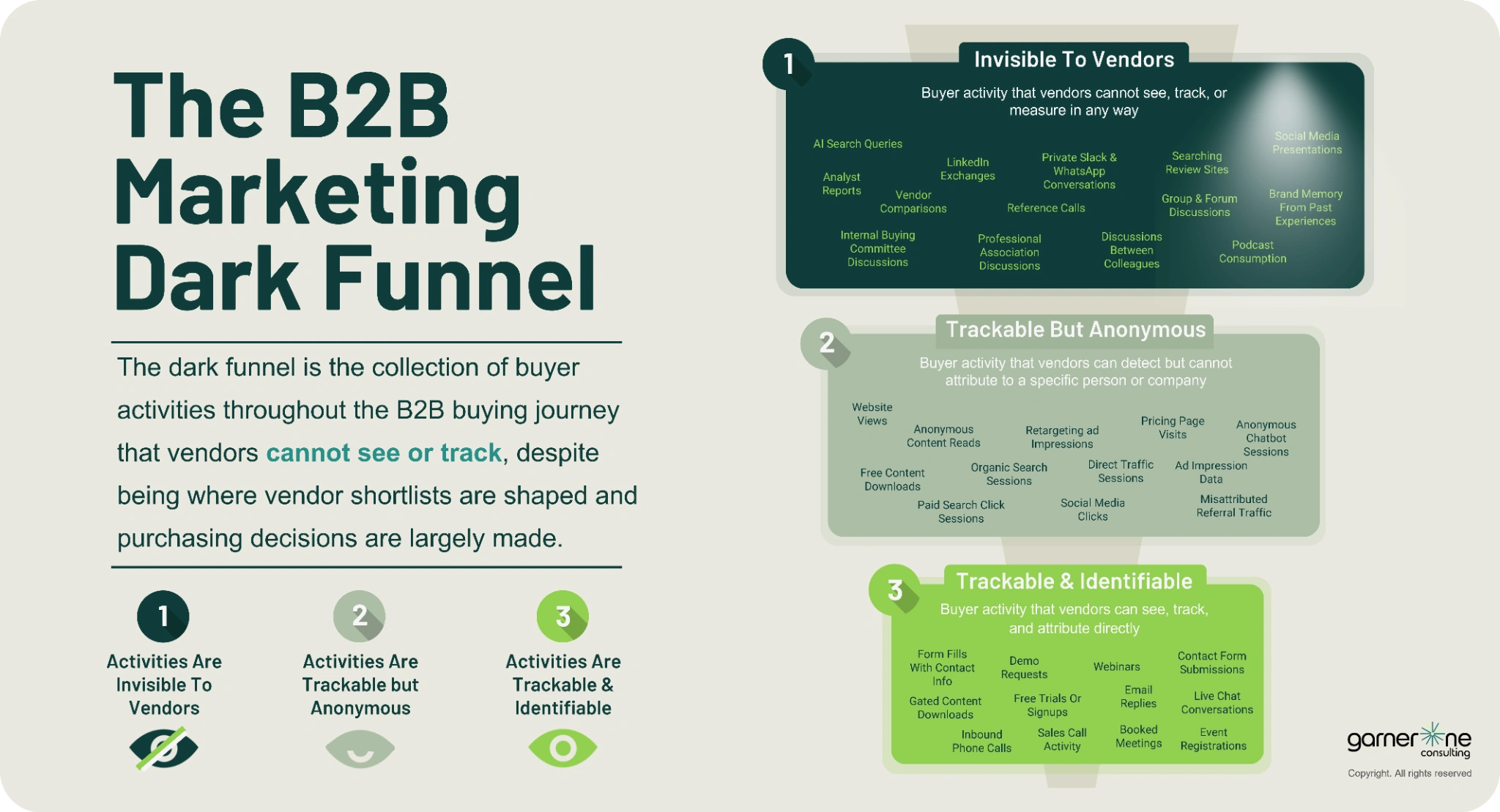
Not all buyer activity is equally invisible. It helps to think about the buying journey in three distinct areas, because each one requires a different response from vendors.
Area 1: Completely Invisible
This is the dark funnel in its purest form. Peer conversations in private Slack groups, WhatsApp threads, professional communities, and internal buying committee discussions. No platform tracks it. No software captures it. A buyer could recommend or dismiss your company in a conversation with three colleagues and you would never know it happened. This is where vendor reputations are made and where shortlists begin forming.
Area 2: Trackable but Anonymous
Buyers are active here but unidentified. Anonymous website visits, content reads, search queries, AI tool interactions, review site browsing. You can see that activity is happening in aggregate but you cannot attach it to a specific buyer or company. Someone has visited your pricing page four times this week. You do not know who.
Area 3: Known and Identified
This is where a buyer makes themselves known. A form fill, a demo request, a direct email, a sales call. You finally know who they are, what they are interested in, and where they came from. This is the area most B2B marketing is built around.
The problem? By the time a buyer reaches Area 3, the shortlist decision is largely already made.
Companies that optimize for Area 3 are optimizing for the moment the decision gets confirmed, not the moment it gets made.
The Six Categories Of The Dark Funnel
The six categories below cover the specific activities that make up Areas 1 and 2, where the shortlist is actually built.
01. Private peer and community influence
Buyers ask people they already believe, not vendors, for recommendations and warnings before they reach out to anyone. That happens in private Slack and WhatsApp groups, in DMs, in LinkedIn groups, inside professional associations, and in quiet reference calls to former colleagues. The pattern underneath all of it is the same: another person’s word carries more weight than your website.
02. Anonymous and misattributed digital research
Buyers read your content, check your pricing, and weigh your proof without ever telling you who they are. Those visits land in your analytics as direct traffic, as incognito sessions, or as nothing at all, even when the same person has been to your site several times. You are being evaluated by people you cannot name and cannot count.
03. Search and AI-assisted discovery
Buyers use search engines and tools like ChatGPT, Claude, Perplexity, and Gemini to frame the problem, build a starting list of vendors, and work out what questions to ask. Around 60% of B2B buyers now use ChatGPT or Gemini to add to their vendor lists and surface competitors (Google, 2025). If those tools do not mention you, you are typically absent from consideration before the shortlist even forms.
04. Third-party validation and comparison
Buyers use reviews, directories, and comparison pages to test your claims against other people’s experience. They read the critical reviews, study competitors’ comparison pages, and look for reasons to remove a vendor from consideration. At this stage they are not learning about the category. They are deciding who is credible enough to consider.
05. Internal buying committee activity
Buyers debate the problem, the budget, the risks, and the vendor options among themselves, often before you know the opportunity exists. Content gets forwarded, screenshots get pasted into planning documents, and a champion argues your case in a room you will never know about. By the time someone reaches out, that internal conversation has usually already reached a conclusion, or is very close to one.
06. Brand memory and market reputation
Buyers carry an impression of your company into every decision they make. That impression accumulates over time through multiple sources: the point of view an executive has consistently put forward in industry conversations, the position a company has taken publicly on a problem that matters to the buyer’s category, the reputation that circulates among peers from past client experiences, the presence a company maintains at the events and in the communities where buyers gather, and the word of mouth that builds quietly across professional networks over months and years. A buyer who reaches the shortlisting stage already carrying a positive impression of your company did not form that impression from your homepage. They formed it from everything else.
What Dark Funnel Presence Actually Does
Across Area 1 categories, the pattern is the same. Buyers are forming a view of which vendors are worth considering long before they make themselves known to those vendors. Area 2 activity refines it. The first few sales conversations in Area 3 can still shift it. But the dark funnel determines who gets taken seriously enough to reach those later stages. A vendor that is absent from the places buyers look during their anonymous research rarely gets the opportunity to make their case in a sales conversation, because they never made it onto the consideration list in the first place.
Being found in the dark funnel is based on an accumulation of effort over time, through every piece of content published, every review earned, every executive contribution made to an industry conversation, and every peer recommendation.
The dark funnel does not usually finalize the shortlist decision, but it shapes who buyers are willing to seriously consider.
B2B Buyers Decide on Their Shortlist Before They Contact a Vendor
By the time a buyer fills out your form, the choice of vendor is often close to made. According to 6sense’s Buyer Experience Report, 84% of deals are won by the first vendor a buyer contacts, indicating that buyers have largely made their decision before any sales conversation begins. In that same report, 78% of buyers had already established their full requirements, including budget, before they engaged with a vendor.
The dark funnel is where those requirements get set and where the shortlist gets built.
This reframes the entire picture. The first sales conversations with a vendor is usually not where the decision gets made. It is where a decision that already happened gets confirmed.
This is what buyers prefer. 67% of B2B buyers say they would rather have a rep-free buying experience according to Gartner (Gartner, 2026). They would sooner read, compare, and ask people they already believe than sit through a discovery call, so they delay contact until they are ready. Sometimes until the question of who gets the business is already settled in their own heads.
There is rarely just one buyer to convince, either. A typical B2B purchase now runs through a buying group of six to ten people (Gartner), and they do most of their research separately. You are not trying to be credible to one champion. You are trying to be credible to several people you will never meet, in places you cannot see, often before any of them has said a word to you.
B2B Marketing today is not there to simply generate visibility at the beginning of the buying process or capture demand at the end. For marketing to be effective, it needs to be credible and findable during the research phase, when buyers are searching, evaluating and considering their potential vendor list.
Consideration to shortlist a vendor does not start when a buyer contacts a vendor. It starts much earlier, in the anonymous research and the peer conversations, and by the time it surfaces it is mostly settled.
Companies that show up credibly across those six categories tend to be on the shortlist before the first conversation with a vendor happens. The vendors that are quiet, hard to verify, have a small presence in online channels or absent from AI and review channels are rarely on it, regardless of how good the product or service is. A strong product with weak dark funnel presence gets passed over for a credible product from a company that is easy to find and easy to verify.
"One of the more consequential opportunities in B2B marketing is being present and credible during that gap between being found and being considered to be shortlisted."
The Buying Process You Cannot See Is the One That Matters Most
A useful question to ask is not how to get more leads. It is: where do buyers in our category form their first impression of us, and what do they actually find when they look?
The answer is always useful.
Go check, directly, with your own eyes.
- Open an incognito window and ask ChatGPT, Claude, Perplexity, and Gemini to recommend vendors for the problem you solve. See whether you appear at all, and read carefully what they say about you when you do. See who they cite and why.
- Then ask three recent customers two questions: where did you first hear our name, and where did you research before you contacted us?
What you find will show you what your analytics dashboard cannot: how your company appears to buyers before they ever identify themselves to you.
Frequently Asked Questions - FAQ
How long does it take to build a credible dark funnel presence?
There is no reliable timeline because dark funnel presence is not built through a single campaign or initiative. It accumulates through repeated, consistent activity across multiple channels over time.
Brand memory forms slowly. Review profiles build incrementally. AI citation probability grows as your content earns more references from independent sources. A reasonable expectation for a company starting from a thin presence is twelve to eighteen months before dark funnel activity begins producing measurable signals like branded search volume growth and self-reported attribution from buyers.
Companies that already have content, reviews, and some executive visibility can accelerate that. Companies starting from scratch typically cannot shortcut it.
Does dark funnel strategy work differently for smaller or lesser-known B2B companies?
Yes, and in one important way it is harder. Larger companies have more content assets, more reviews, more case studies, more testimonials, more brand mentions and carry brand memory into every buying conversation because buyers have encountered them repeatedly across many contexts over years. A smaller company with less content assets has to earn that familiarity deliberately in a shorter time with fewer resources. The practical recommendation here is that smaller companies need to be more specific, not broader. Owning a narrow topic or problem category completely is more effective than trying to build presence across a wide market. A buyer who consistently encounters your company as the clearest voice on one specific problem will remember you when that problem becomes urgent, regardless of your size.
What is the difference between dark funnel strategy and demand generation?
Demand generation is typically organized around creating and capturing identifiable interest, through campaigns, ads, gated content, and lead forms, in channels you can track and measure. Dark funnel strategy is organized around building credibility and presence in the channels where buyer opinions form before any identifiable interest exists. The two are not opposites. Demand generation captures what dark funnel activity creates. The problem most B2B companies have is that they invest heavily in demand generation and almost nothing in the dark funnel activity that makes demand generation more productive. When buyers already know and respect your company before your demand generation reaches them, conversion rates improve and sales cycles shorten.
What is the difference between the dark funnel and dark social?
Dark social is one piece of the dark funnel. The term refers specifically to private content sharing that attribution tools cannot trace: a link forwarded in a text message, an article shared in a Slack DM, a screenshot posted in a WhatsApp group. The visit shows up in your analytics as direct traffic with no indication of what prompted it.
The dark funnel is the broader concept. It covers all untrackable buyer activity, including dark social but also peer recommendations, AI tool research, podcast listening, review site browsing, internal buying committee discussions, and the brand impressions buyers carry from past encounters. Dark social describes how content travels invisibly. The dark funnel describes where buying decisions take shape invisibly.
How do I make the case internally for investing in something we cannot directly measure?
Many companies do not invest in the dark funnel because it produces no or low data, reports, metrics, or attribution. So it gets ignored in favor of channels that do produce data. That is a significant misalignment between where buying decisions are shaped and where marketing investment goes.
A practical approach is to shift the conversation from campaign metrics to leading indicators.
- Self-reported attribution from a simple open-text field on your contact forms tells you which dark funnel channels buyers actually remember.
- Sales conversation quality. Are buyers arriving more informed and further along in their decision? Track how many questions buyers ask that your content already answers.
- Time to decision. Are sales cycles shortening as buyer confidence builds?
- AI citation frequency. Is your company being cited by AI engines when buyers research your category?
- Direct and branded search volume. Are more buyers searching specifically for your company by name? That is a signal that your presence is registering during the research phase.
- Content engagement depth. Are buyers reading multiple pages, downloading proof assets, and spending meaningful time with your content during the evaluation phase?
- Referral and word of mouth signals. Are buyers arriving already familiar with your company without a traceable campaign source?
None of these are perfect proxies, but together they build a picture that leadership can connect to pipeline quality. The argument is not that dark funnel investment is unmeasurable. It is that it requires different signals than the ones your current dashboard was built to show.
If the dark funnel is invisible to vendors, how do competitors use it against you?
They do not need to target you directly. They simply need to show up more credibly and consistently than you in the channels buyers use during their research. A competitor whose executives are regularly referenced in industry conversations, podcasts, whose content appears when buyers ask AI tools for vendor comparisons, whose reviews are current and specific, and whose name circulates positively in peer communities will be on more shortlists than a competitor who is strong on product but quiet everywhere else. The dark funnel does not reward the best product. It rewards the most credible and consistently visible presence in the places buyers look before they contact anyone.