- The Antidote to B2B Marketing Chaos
- A Structured Marketing System
- Get on the shortlist

Go From Being Found to Being Chosen
Your Goal Is To Earn Buyer Confidence
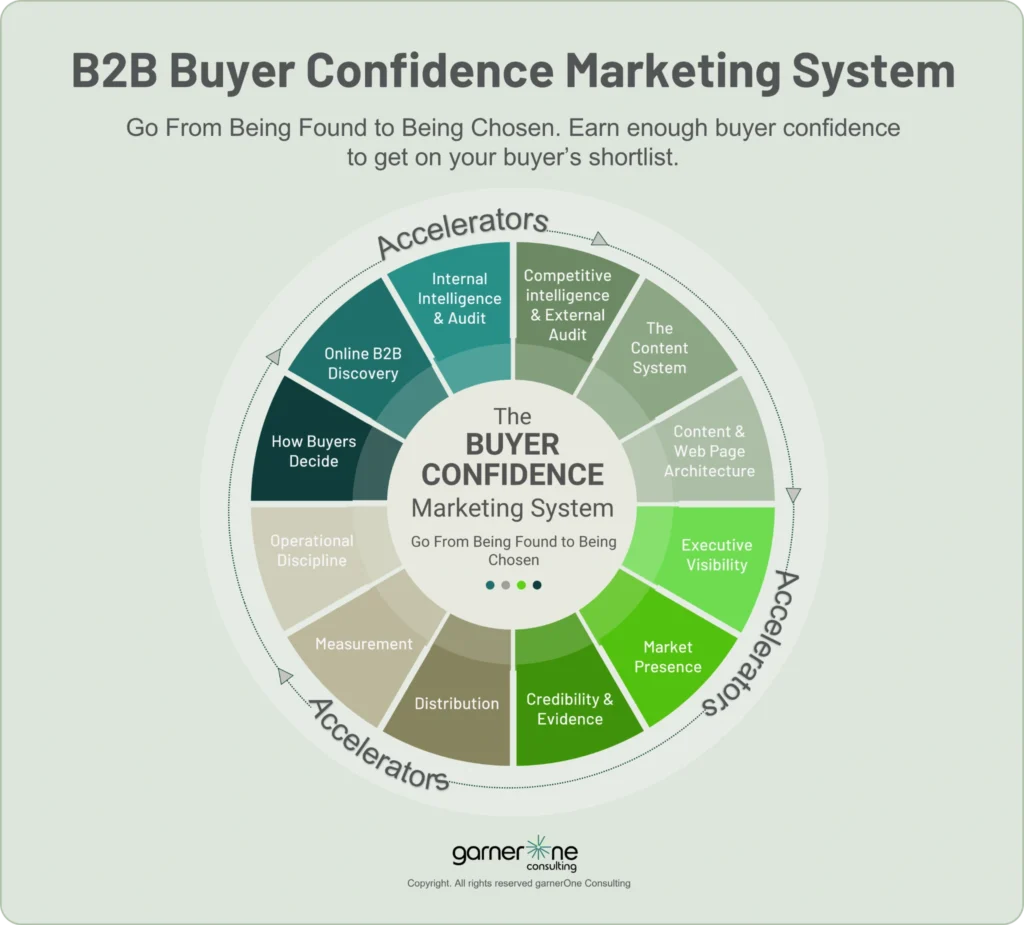
The Buyer Confidence Marketing System is garnerOne’s structured approach to B2B marketing.
The system organizes the right marketing strategies and tactics into a clear sequence built around one outcome:
→ earning buyer confidence.
The mechanism that earns that confidence is credibility.
The system is thorough, but the concept at the center of it is straightforward: credibility is what buyers need to feel confident enough to choose you.
Build the content, proof, and visibility that demonstrates it consistently.

Build Credibility, Earn Buyer Confidence
Every section of this System builds credibility in a specific way.
Through content that demonstrates genuine expertise. Through proof that exists outside your own website. Through executive presence that buyers encounter during their research. Through consistent signals across channels you do not own or control.
Companies that build credibility systematically earn buyer confidence as a result.
Earn Buyer Confidence, Generate Demand
B2B marketing strategy typically addresses visibility or conversion. This System addresses what happens in between, the research and evaluation phase where buyer confidence is either earned or lost, and where most companies have no clear structure.
The System is built around one causal chain:
Build Credibility → Earn buyer confidence → Increase shortlist probability → Generate qualified demand
The System organizes the right strategies and tactics into a clear sequence that addresses how buyers find you, how they evaluate you, and what determines whether they put you on their shortlist before they ever contact sales.
This system is the methodology garnerOne uses with ongoing clients to build marketing that lasts.
What The System Is Built To Do
Buyers need to feel certain that you understand their problem, that your solution fits their situation, and that choosing you is a decision they can defend internally.
That certainty forms during the research phase, long before they contact sales.
The System is built to earn it there.
Building credibility systematically earns buyer confidence. It also earns AI citation authority.
Buyers and AI engines are asking the same question: is this company credible enough to trust?
For AI systems, the answer determines whether you get cited. For buyers, it determines whether you get shortlisted. AI systems and search engines do not surface the best content. They surface the most credible.
The System builds those signals deliberately.
Marketing teams and leadership need to see that the work is producing measurable outcomes, not just activity.
When visibility is increasing, credibility is building, and buyers are progressing toward decisions, leadership protects the investment instead of cutting it.
The System makes that progress visible.
Overview: What The System Covers
Structuring Around How Buyers Decide
Whether your marketing is organized around how buyers actually research and decide, or around internal activity and assumptions.
Understanding Modern B2B Discovery
How buyers find companies today, where they spend their research time, how AI search concentrates visibility, and what that means for how your company needs to show up.
Internal & External Audits
A structured assessment of your owned marketing assets and how your company is perceived outside of them. Covers your website, content, messaging, and evidence internally, and how buyers, search engines, AI systems, and competitors see you externally. The output is a clear picture of where you stand.
The Content System
How your content is organized across the buyer journey, which content functions are missing or thin, and what a complete content system looks like for your specific situation.
Content & Webpage Architecture
Whether your content is structured so AI systems and search engines can find it, extract meaning from it, and reference it accurately.
Executive Visibility
Whether your executives show up consistently in the channels buyers use during their research, with a recognizable voice and credible point of view, and how that personal visibility compounds into organizational authority and AI citation probability.
Market Presence
Whether your company has a credible presence beyond its own channels, through analyst mentions, podcast appearances, guest contributions, event participation, and industry community involvement, and how that external presence influences both buyer perception and AI citations.
Credibility & Evidence
Whether the proof buyers and AI systems look for, case studies, testimonials, reviews, and third party mentions, is present, visible, and accessible where buyers are looking.
Distribution
Whether your content is actually reaching buyers during their research, and whether your company has a credible presence in the peer communities and professional networks where buyers validate vendor choices.
Measurement
Whether you are tracking signals that reflect buyer confidence and progression, not just traffic and leads.
Operational Requirements
Whether the operational structure, executive alignment, processes, tools, and accountability needed to sustain the System over time is in place.
Accelerators
Whether specific approaches exist that could significantly speed up results given your situation, goals, and resources.
Table of Contents
DETAILS: THE B2B BUYER CONFIDENCE MARKETING SYSTEM
What follows is a more detailed look into the Full Buyer Confidence Marketing System.
It covers every section of the System at a level that gives you a clear picture of what it contains and why it matters.
UNDERSTANDING
Every engagement begins with a structured session that combines what you already know about your buyers with current research on how B2B buyers search, evaluate, and decide online today. garnerOne brings insight on how modern discovery, AI search, and buyer behavior have shifted what it takes to get found and chosen. You bring knowledge of your specific market, your buyers, and how decisions actually get made in your category. Together, those two inputs form the foundation that shapes everything the System builds from there.
Section 1: Structuring Around How Buyers Decide
Most companies structure their marketing around internal activity, calendars, campaigns, and quarterly targets. Buyers do not decide based on how much content you publish or how many channels you show up on. They decide in stages, and at each stage they need to believe something specific before they move forward.
This section establishes the six stages B2B buyers move through when making vendor decisions, and maps your marketing structure against how your buyers actually progress toward a decision. The gap between the two is often where results are being lost.
At each stage, what moves a buyer forward is not more information. It is a specific credibility signal that makes the next step feel safe.
How buyers find and evaluate companies has shifted significantly and most B2B marketing decisions are still built on assumptions that no longer reflect reality. This section covers where buyers actually spend their research time outside of your website, how AI search engines determine which companies to surface and which to ignore, and why traditional search rankings remain relevant even as AI reshapes the discovery landscape.
The output is a clear picture of where your company currently stands in the channels and systems your buyers are actually using.
Where your company appears during a buyer’s research is itself a credibility signal. Consistent presence across the right channels tells buyers you are worth considering before they have read a word you have written.
Too many companies start executing before they understand where they actually stand. They guess at what buyers need, assume their content is working, and wonder why results are inconsistent.
Intelligence is the diagnostic phase of every garnerOne engagement. Before any strategy is recommended or any content is built, garnerOne conducts a structured audit across two dimensions: what is happening inside your marketing and what is happening outside of it. The findings from this phase directly inform every decision that follows.
garnerOne conducts a structured review of what your company owns and controls in terms of impacting buyer confidence.
This covers your website structurally, your content across all formats and channels, your evidence assets and how accessible they are to buyers, and how clearly your messaging communicates what you do and who you do it for.
The output is an honest assessment of where your owned marketing is working, where it is falling short, and where the most immediate opportunities exist.
The audit assesses one thing above all: does what you own and control give a buyer enough reason to consider you credible before they look anywhere else.
garnerOne assesses how your company is perceived and referenced in the systems and channels outside your control.
This covers how search engines are currently ranking and referencing you, what AI systems are citing in your category, what buyers are actually searching for, and how consistently your brand appears across third party platforms.
It also includes a structured competitive analysis: what content competitors have built, where they show up in search and AI results, where they are credible and authoritative, and where gaps exist that your company can realistically address.
The output is a clear picture of how buyers and AI systems currently see you relative to your competitors, and where the most actionable opportunities exist.
External signals carry more weight than anything you publish about yourself. Buyers and AI engines both treat third party references, mentions, and rankings as the most reliable indicator of whether a company is credible enough to trust.
The Build pillar is where strategy becomes execution. Using the foundation established in Understanding and the gap analysis from Intelligence, garnerOne structures the confidence-earning engine across six areas. Each one addresses a distinct part of how buyers find, evaluate, and decide on vendors. Together they form a system that gets your company found, cited, and chosen.
Many companies produce content reactively. The result is a collection of disconnected assets that generates activity but does not systematically build buyer confidence across the research journey.
garnerOne organizes and maps your content around what buyers actually need at each of the six decision stages. This covers two content paths:
- website-native content structured for buyer engagement, search discovery, and AI citation
- platform-native content built for the channels where your buyers already spend time.
Within each path, content is mapped to four functions:
- Building awareness
- Establishing authority
- Supporting buyer decisions
- Driving adoption after the sale
Content that demonstrates genuine expertise, such as original research, in-depth guides that answer specific buyer questions, named expert commentary, and comparison content that helps buyers evaluate options, is the first and most scalable credibility signal a company can build. It is what buyers encounter during research and what AI engines evaluate when deciding which companies are credible enough to cite.
The Content System also addresses what to gate, what to offer as a lead magnet, and how to sequence conversion opportunities across the buyer journey so that content which earns buyer confidence has a clear mechanism for converting that confidence into an identifiable lead.
The deliverable is a complete content system with a clear structure, a defined mix, and a production plan that ensures the right content exists in the right place at the right stage of the buyer journey.
Content architecture determines whether AI systems and search engines can extract meaning from your pages, classify your business correctly, and cite your content with confidence. A company can produce genuinely useful content and still be ignored by AI systems if the underlying structure makes it difficult to interpret.
garnerOne develops the structure for your most important pages and site architecture so information is easy to extract, easy to navigate, and easy to reference. This covers how pages are organized, how topics are connected, and how your content signals authority and relevance to the systems that determine whether buyers find you during their research.
A well-structured page signals to AI engines and search systems that the company behind it is organized, clear, and reliable. Credibility is not just what you say. It is whether the systems buyers use to research can find it, read it, and trust it enough to reference it.
Buyers do not only evaluate companies. They evaluate the people behind them.
When executives show up consistently in the channels buyers use during research, with a clear point of view and recognizable voice, it creates a confidence signal that corporate content alone cannot produce.
Unlike Content Marketing Systems, Executive Visibility cannot be delegated to content writers or managed through an editorial calendar in the marketing department. It requires the executive’s actual voice, judgment, and consistent participation across the platforms where buyers and AI systems form impressions about your company and its leadership.
The System addresses how executive visibility is developed, where it should show up, and how it connects personal brand to company credibility and AI citation probability.
A company with visible and credible executives are easier to cite and trust and are one of the strongest credibility signals both buyers and AI engines recognize. Executive presence is one of the few credibility signals that cannot be replicated by a competitor with a larger content budget.
A company’s credibility is not determined solely by what it publishes on its own channels.
A company that shows up consistently in places it does not own or control is more credible than one that does not. Third-party mentions, analyst references, and industry coverage are the external validation that both buyers and AI engines weight most heavily and treat as independent verification that a company is worth considering. A company that only exists on its own channels gives neither buyers nor AI engines enough independent evidence to trust it.
Market Presence covers the external signals that build credibility beyond owned content: analyst mentions, podcast appearances, guest contributions to industry publications, event participation, community involvement, and industry forum visibility. These signals tell buyers that others in the industry consider your company worth referencing. They tell AI systems the same thing.
When budget allows, PR and media relations are also part of a complete market presence strategy. Earned media coverage in relevant publications accelerates the credibility signals that both buyers and AI systems use to evaluate vendors.
The System addresses how to identify where your market presence currently stands, where the most credible opportunities exist for your specific category, and how to build a consistent external presence that impacts credibility over time.
Everything built before this section creates the conditions for credibility. This section is where proof of it is made visible, accessible, and impossible to ignore.
Buyers do not want more explanations. They want proof.
Everything built in the sections before this one, content, architecture, executive visibility, market presence, is preparation. This is the section where buyer confidence is either earned or it is not.
Credibility and evidence is what determines whether a buyer shortlists you. Not your positioning. Not your visibility. Not how much content you have published. Buyers are making decisions that affect their business and their reputation. Before committing to a vendor, they look for proof that the choice is defensible.
If they cannot find it, they move on. They do not ask for it. They simply consider someone else.
This is also where AI systems make their determination. Evidence is one of the primary signals AI engines use to decide whether a business is credible enough to cite. A company can have strong content and solid architecture and still be ignored by AI systems if the underlying proof is absent, buried, or impossible to verify.
Most B2B companies have proof. Client outcomes exist. Case studies have been written. Testimonials have been collected. The problem is that proof is often buried in PDFs nobody finds, written in a way that sounds promotional rather than specific, or scattered across the site with no clear structure.
garnerOne identifies, organizes, and presents your credibility assets in a way that is easy for buyers to find at the moment they are looking, and easy for AI systems to extract and reference. This covers how credibility assets are created, accumulated, organized, and maintained over time so that proof compounds rather than sits idle.
Companies that get this right show up on more shortlists and get cited more reliably by AI systems. Companies that do not often lose deals not because proof does not exist, but because buyers and AI systems could not find it.
This is not an optional strategy. Buyers rarely trust what they see once.
Publishing content is not the same as getting content seen.
Too many B2B companies underinvest in distribution and overproduce content that never reaches the buyers it was created for.
Credibility that no one encounters does not compound. Distribution is what converts the work built across every other section into signals that buyers and AI engines actually find during research.
garnerOne develops a distribution strategy that ensures your content travels beyond the place it was created.
- Website content needs to be amplified across channels to drive discovery.
- Platform content needs to be repurposed and cross-promoted to extend reach.
AI systems evaluate the entire web of activity around your brand, not just your website, so content that gets referenced, linked, shared, and reused across platforms builds credibility signals that influence both buyers and AI systems simultaneously.
Distribution also covers identifying a credible presence in the peer communities and professional networks where buyers validate vendor choices. Buyers increasingly rely on conversations in communities they already participate in, industry forums, LinkedIn discussions, and peer referrals, to confirm or challenge the impressions they formed during research.
If your content isn’t distributed intentionally, it may exist, but it won’t influence. Worse, competitors with weaker ideas but better distribution will shape the narrative instead and reach more buyers.
Building a content and marketing system is one challenge. Keeping it performing over time is another. Most marketing systems degrade quietly. Strategy gets ignored under the pressure of day to day execution. Priorities shift. Consistency erodes. The Discipline pillar ensures the System holds over time by establishing how progress is measured and how the operational requirements that sustain it are met.
Section 11: Measurement
Companies still measure marketing effectiveness based on traffic, leads, and last touch attribution. Those numbers do not reliably reflect whether buyer confidence is actually building. Buyers form opinions long before they fill out a lead form. AI systems surface and summarize content without always sending traffic. Social channels capture engagement that never shows up on your website. If you only measure what was relevant years ago, you will misread good strategy and cut the work that actually influenced the decision.
Establish a measurement framework focused on signals that show real progress:
- Sales conversation quality. Are buyers arriving more informed and further along in their decision? Track how many questions buyers ask that your content already answers.
- Time to decision. Are sales cycles shortening as buyer confidence builds?
- AI citation frequency. Is your company being cited by AI engines when buyers research your category? This can be tracked through tools like Profound, Brandwatch, or manual AI query testing.
- Direct and branded search volume. Are more buyers searching specifically for your company by name? That is a signal that your presence is registering during the research phase.
- Content engagement depth. Are buyers reading multiple pages, downloading proof assets, and spending meaningful time with your content during the evaluation phase?
- Referral and word of mouth signals. Are buyers arriving already familiar with your company without a traceable campaign source?
Measuring only traffic and leads will cause you to misjudge good strategy.
The metrics that matter are the ones that reflect whether credibility is building. AI citation frequency, share of voice across AI platforms, branded search growth, and sales conversation quality tell you whether buyers and AI engines are finding your company credible enough to consider.
Section 12: System Requirements
Many marketing systems do not fail because the strategy was wrong. They fail because the operational discipline required to sustain them was never established.
Executive buy in fades. Processes are not documented. Tools are underused. Accountability becomes unclear.
garnerOne identifies the operational requirements specific to your organization that keep the System performing consistently over time. This covers:
- executive alignment
- standard operating procedures
- the tools and platforms that support execution
- departmental accountability structures
The output is a clear operational framework that defines how the System is run, who is responsible for what, and how performance is maintained as the organization evolves.
Credibility compounds when signals are consistent over time. Inconsistent execution produces inconsistent signals, and inconsistent signals give buyers and AI engines reason to discount you. Operational discipline is what keeps the System producing credibility at the level that earns trust.
ACCELERATE
The System described across Understanding, Intelligence, Build, and Discipline can produce results on its own. The Accelerate pillar presents a set of optional force multipliers that amplify a system that is already working. None of these are required.
However, each accelerator works because it amplifies credibility signals already in motion. Although none replace the foundational work of the system, all of them make the credibility you have built more visible, more consistent, and more difficult for competitors to replicate.
Section 13: Accelerators
garnerOne presents the following accelerators that can be applied at any point once the core System is in place:
Use a Framework. Organizing content and marketing execution around a repeatable framework reduces decision fatigue and ensures consistency across teams. Companies that operate from a clear framework execute faster and maintain quality over time without constant re-decision making.
Buyer Confidence as Culture. When every department, product, sales, customer success, contributes to earning buyer confidence, marketing compounds across the entire organization. This turns buyer confidence from a marketing responsibility into a company-wide mission. The results go beyond what marketing activity alone can produce. For clients ready to explore this further, the Buyer Confidence as Culture page outlines what that commitment actually requires.
Audience Ownership. Building a direct audience through email, communities, and owned channels reduces dependence on platform algorithms. Companies that own their audience can reach buyers repeatedly without asking permission from platforms whose priorities will continue to change.
Paid Media. Strategic use of paid channels amplifies your strongest content to precise audiences, accelerating reach and building brand recognition in areas where organic discovery is slow or where competitive pressure is high.
PR and Media Relations. Third party coverage in industry publications, analyst mentions, and media appearances accelerate the credibility signals that buyers and AI systems use to evaluate vendors. Companies with a strong thought leadership foundation and credible brand presence get significantly more value from PR investment than those without it.
AI search and modern discovery have created an uneven playing field for smaller B2B companies.
Large companies have structural advantages that are difficult to match: extensive content libraries, substantial review profiles, strong citation networks, robust backlink profiles, and dedicated marketing teams.
AI systems favor these signals because they reduce risk. When evaluating between a well-documented enterprise solution and a lesser-known SMB, AI systems default to the safer, more familiar choice.
SMBs cannot compete on volume. Outproducing enterprise competitors is not a realistic path forward.
But volume is not the only way to compete.
The Buyer Confidence System works for SMBs precisely because it focuses on what smaller companies can control: being genuinely useful to a specific and well-defined audience.
Depth beats breadth. A company that completely owns two or three topics for a clearly defined buyer is more credible to that buyer than a large competitor covering everything shallowly.
garnerOne works with SMBs to adapt every pillar of the System to their specific constraints, including where to focus limited resources for maximum impact, how to build credibility signals that close the gap with larger competitors over time, and where large companies are structurally weak in ways that smaller, more focused companies can take advantage of.
The playing field is not equal. But it is not fixed either. SMBs that follow this System with focus and discipline will find that specificity, depth, and genuine usefulness are advantages that budget alone cannot buy.
Companies investing in AI search optimization and companies investing in earning buyer confidence are often treated as pursuing two separate strategies.
They are not.
The signals AI engines use to decide which companies to cite are identical to the signals that make buyers confident enough to choose a vendor.
Credible content that answers specific buyer questions. Executive visibility on platforms buyers and industry peers already trust. Third party mentions, backlinks, and references from sources outside your own website. Consistent market presence across channels you do not own.
These are the activities the Buyer Confidence System builds. They are also exactly what AI engines evaluate when deciding which companies are credible enough to cite.
Companies that invest in the Buyer Confidence System are not choosing between building buyer confidence and optimizing for AI search. They are doing one body of work that produces both outcomes simultaneously.
A company that earns buyer confidence consistently across the buyer journey is already building AI citation authority without treating it as a separate investment.
There is one distinction worth noting. Some AI search optimization is purely technical. Page structure, heading hierarchy, internal linking, and site architecture are legitimate disciplines that every B2B company should address. The Buyer Confidence System covers that through Content and Web Page Architecture.
But the strategic investment, the content, credibility, executive visibility, market presence, and distribution that determine whether AI engines consider your company a credible and authoritative source, is built through the System as a whole.
Many B2B companies are not struggling because they lack ideas or effort. They are struggling because their marketing is not structured around how buyers actually decide.
The Buyer Confidence System is not about doing more. It is about doing the right things in the right order, built around the one outcome that determines whether buyers put you on their shortlist: confidence.
When buyers consistently find what they need during their research, when your company shows up with clarity at every stage of their decision process, and when the evidence they need to justify choosing you is easy to find, something shifts. Sales conversations start further along. Deals move forward with less friction. The company becomes easier to choose, not because marketing got louder, but because it got more useful.
You do not need to implement every section of this System at once. But you do need to implement it intentionally. The companies that struggle to earn buyer confidence are rarely short on content or budget. They are short on structure.
That is what this System provides.
How garnerOne Delivers This System
B2B Marketing Audit
The starting point for any engagement.
garnerOne conducts a structured assessment of your current marketing against the System’s framework, identifying where you are invisible, incomplete, or unclear to buyers.
You receive a prioritized gap analysis and a clear picture of where to focus first.
The audit is available as a standalone engagement for companies not yet ready to commit to a full System implementation.
Strategy and Advisory
For companies ready to act on what the audit reveals.
This engagement includes the audit and delivers a structured marketing roadmap across all thirteen sections of the System.
garnerOne advises on what to build, in what order, and why, and remains actively involved throughout execution to ensure the strategy holds as your team implements it.
Implementation and Execution
For companies that want garnerOne to do the work.
This engagement includes the audit and strategy phases, then moves into execution. garnerOne executes the work across the relevant sections of the System.
Scope is determined based on client needs, priorities, and internal capacity.
Your team is involved throughout but garnerOne leads the execution.
Ready to explore what this looks like for your company?
The right starting point depends on where you are. If you want to understand your current gaps before committing to a full engagement, the Buyer Confidence Audit is where most clients begin. If you already know where you stand and are ready to act contact us for a discussion.
If you are not sure where your gaps are, the B2B Marketing Confidence Scorecard is a free self-assessment that helps you identify where your marketing is working and where it is not.