
Hard to Track Does Not Mean Impossible to Evaluate
The point of tracking dark funnel activities is to stop misdirecting budget.
When you can see that dark funnel activity is shaping how buyers think about you, you can fund it appropriately.
Although dark funnel activity is absolutely critical to track, it’s hard to do so, especially when counting on modern attribution tools.
Now, hard to track is not the same as impossible to evaluate, and treating them as the same thing is where a lot of B2B marketing budgets get misdirected.
This article is about the evaluation and measurement of dark funnel activities. It shows how to read those activities using 6 specific signals in comparison to flawed last-touch attribution.
Table of Contents
A Brief Orientation on the Dark Funnel
Let’s provide a short orientation before we get into the details.
The dark funnel is the collection of buyer activities throughout the B2B buying journey that vendors cannot see or track, even though that is where shortlists are shaped and purchasing decisions are largely made. A buyer reads, compares, asks peers, and runs queries through AI tools long before they ever fill out a form. Almost none of that shows up in a vendor’s analytics.
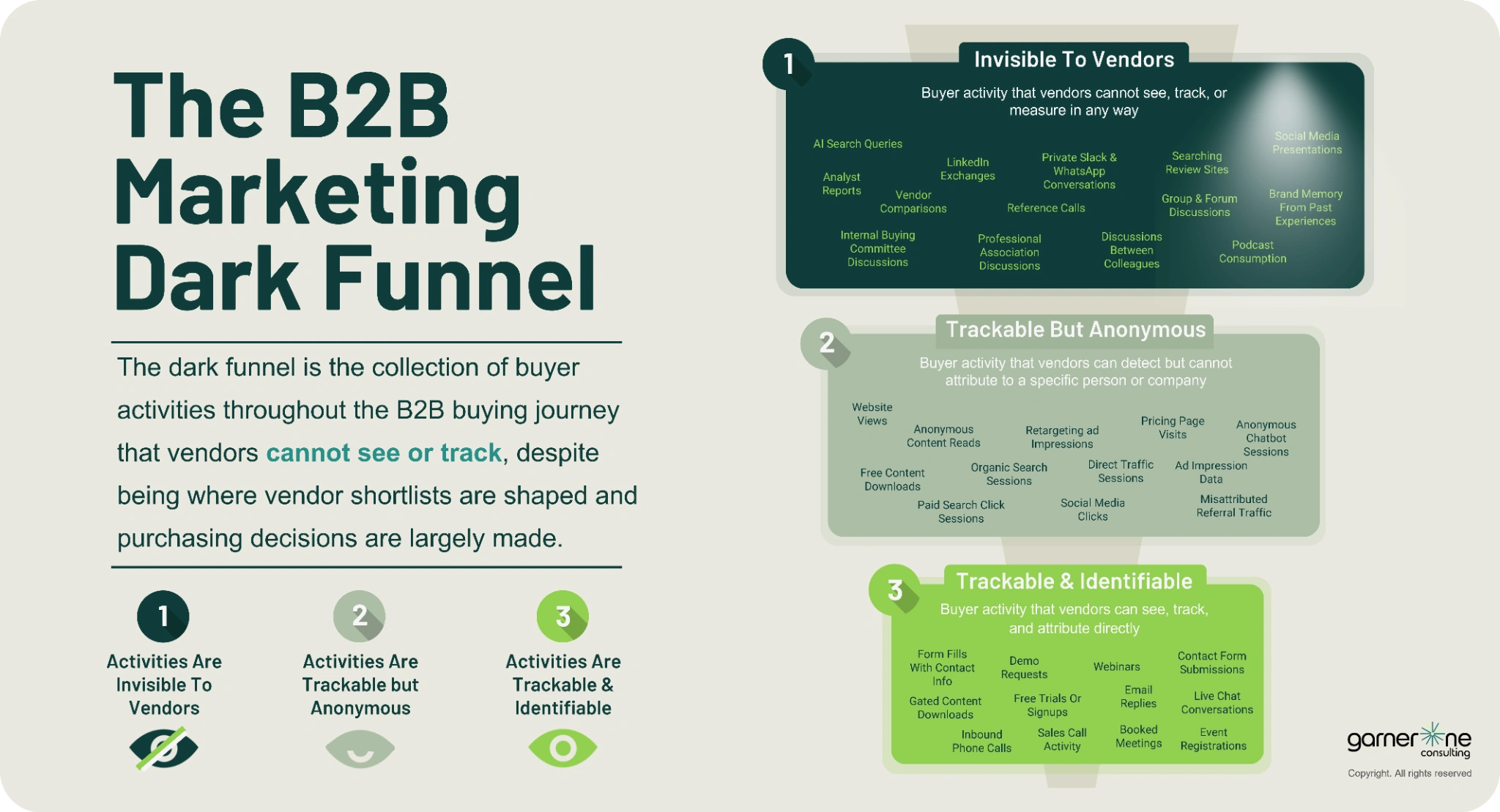
That activity sits across three areas of visibility.
Area 1, Completely Invisible, is buyer activity vendors cannot see, track, or measure in any way, such as peer conversations, AI queries, and internal discussions.
Area 2, Trackable but Anonymous, is activity vendors can detect but cannot attribute to a specific person or company, such as page views, email opens, and ad clicks.
Area 3, Known and Identified, is activity vendors can see, track, and attribute directly, such as demos, forms, and sales calls.
Last-touch attribution measures Area 3 well and misses almost everything in Area 1 and Area 2. This article focuses on those first two areas, because that is where the buyer research happens and where the measurement gap sits.
For the full explanation of what the dark funnel is and how it shapes the shortlist, read the article titled: What is the B2B Dark Funnel & How Does It Shape the Vendor Shortlist.
The Research the Buyer Does Before Getting Noticed Is the Part You Cannot See.
By the time a buyer books a demo or fills out a form, the important research is already behind them.
They have read your material and your competitors’. They have asked people they trust. They have run questions through AI tools and compared what came back. They have sat in internal conversations about which vendors are worth a closer look. The shortlist took shape across all of that, and a vendor either made it onto that shortlist or did not, well before the vendor realized or heard a thing.
The problem is that this research leaves almost no trace a vendor can point to. A demo request is easy to record. The weeks of evaluation that led to it are not.
So when a marketing team looks at its reporting, the demo shows up and the research that produced it does not, which makes the research the buyer did beforehand look like it contributed nothing.
This is how budget gets misdirected. Money flows toward the channels that can prove they closed a deal. The channels that shaped the buyer’s decision earlier, but cannot prove it, slowly lose their funding.
Over time, a company ends up spending more on the moment a buyer says yes and less on everything that led the buyer to consider saying yes at all.
Why Last-Touch Attribution Is Flawed
Last-touch attribution gives credit to the final click before a deal closes. The webinar sign-up, the demo request, the branded search that came right before the form. Whatever the buyer touched last gets credit for the entire decision.
The flaw is in that last word. One touch gets credited for a decision that was built over weeks or months.
By the time a buyer clicks and gets recorded, they have already read, compared, asked peers, and largely made up their mind. The final click is often just the buyer raising their hand after the decision is made.
Last-touch assigns that click the reason for the decision and ignores everything that did the actual persuading.
Despite this flaw, last-touch attribution has survived because it is the easiest thing to measure. The last click is recorded, timestamped, and already sitting in the system, so it needs no survey, no interviews, no verification. Everything before it is harder to capture, so the model leaves it out. The result is a number that is simple to report and consistently wrong about where the decision was made.
There is a second flaw. The companies that sell attribution software have a natural incentive to measure what their software can measure. What falls outside their software falls outside their reports. Over time, the market learns to value what shows up in those reports, not what actually moved the buyer.
Put those flaws together and you get a model that is easy to defend in a meeting, but wrong about what shaped the decision.
It rewards the channel that was present at the demand capture stage and overlooks every channel that shaped demand creation.
A vendor that optimizes around it is optimizing for the moment the decision gets confirmed, not the moment it gets made.
"A vendor optimizing for the last click is optimizing for the moment the decision gets confirmed, not the moment it gets made."
A Different Way to Think About Measurement
Indirect measurement is not a workaround or a lesser substitute for direct attribution. It is how you evaluate any activity that shapes a decision without producing a click.
You will not get a clean line from one touch to one closed deal, because that line does not exist for activity that happens before the buyer identifies themselves.
What you can get is a set of signals that, when read together over time, show whether your dark funnel activity is shaping buyers the way you intended. The rest of this article is those signals.
The Six Signals Worth Tracking
Dark funnel activity does not produce a clean line to a sale, so you measure it the same way you would measure anything else that works before the buyer identifies themselves.
You watch a set of signals over time, and you read them together. One signal moving on its own can mislead. Several moving in the same direction tells you something real is happening.
Here are six signals worth tracking. None of them prove a single deal came from a single source. However, together they show whether your dark funnel activity is shaping buyers the way you intended.
01. Deal quality and sales cycle
This signal looks at whether the people reaching out are better prepared than they used to be, and whether deals are closing faster as a result.
Why: When a buyer has researched you privately before reaching out, they arrive informed. They ask sharper questions, raise fewer basic objections, and spend less time being convinced of things your content already settled. A buyer who arrives ready to confirm rather than ready to start did most of that work somewhere you could not see.
How: Track qualification rates and sales cycle length over time, and ask your sales team whether new conversations begin at a more advanced point than they did a year ago.
02. Repeat and in-depth research behavior
This signal looks at how anonymous visitors behave on your site before they identify themselves.
Why: The signal is not raw traffic, because traffic comes from everywhere. The signal is the pattern of serious evaluation. Someone who comes back three times to read your case studies and pricing before reaching out is showing you the shape of a private evaluation.
How: Your analytics already reports returning visitors and how many sessions happen before a conversion, and several tools can resolve repeat activity at the company level if you want a fuller picture. Read it as a trend rather than a precise count, because no tool catches every return across devices.
03. Self-reported attribution
This signal is what buyers tell you directly about how they first heard of you and what shaped their decision.
Why: The answers will often name a podcast, a peer, an AI tool, or a piece of content that never appeared in your analytics. This is the most direct way to hear about activity your software cannot see, told to you by the person who experienced it.
How: Add a “how did you hear about us” field to your forms, and ask the same question in sales calls and win/loss interviews. No single answer means much, but patterns across dozens of them point to the channels that are actually influencing buyers.
04. Branded search and direct traffic
This signal tracks how many people search for your company by name and arrive at your site directly.
Why: A buyer who searches your name or types your URL already knows who you are, and that awareness formed somewhere you could not track. This matters more now because of how AI research works. When a buyer gets a recommendation from an AI tool, they rarely click a link. They search your name afterward, so the visit lands as branded search or direct traffic with no trace of the AI conversation that drove it.
How: Use Google Search Console as your baseline, filtering for branded queries to see how often people search your name and reach you. Add third-party tools if you want to benchmark your branded search volume against market peers. Watch all of this as a trend over time, since a steady rise is the signal.
05. AI citation and share of voice
This signal tracks whether AI tools mention and cite your company when buyers ask the questions your buyers actually ask, and how often you appear compared to competitors.
Why: This is the fastest-growing part of the dark funnel, and unlike most invisible activity, it is something you can check directly. If buyers research through AI and you are absent from those answers, you are missing from the conversation before it reaches you.
How: Decide on a set of buyer-intent questions, run them across the main AI tools on a regular cadence, and record whether you show up, how you are described, and who shows up instead of you. Several software tools can automate this tracking, or you can do it manually with a fixed question set and a spreadsheet.
06. Mentions and sentiment in the communities where buyers talk
This signal tracks where your company comes up in the places B2B buyers gather, and how people talk about you there.
Why: Peer conversation is where a lot of shortlists quietly take shape, so the mentions you can see point to a much larger conversation you cannot. A rising number of negative mentions is a different story than a rising number of recommendations, so the tone matters as much as the count.
How: Watch Reddit, LinkedIn, X, and the industry communities relevant to your market, not consumer platforms where your buyers are not making business decisions. Several tools can already monitor this, and manual checks of the communities you already know your buyers use will also catch some of these mentions.
Final Thoughts
None of these six signals will give you the clean line from one touch to one sale that last-touch attribution promises. That line does not exist for activity that happens before a buyer identifies themselves, and any tool claiming otherwise is selling certainty it cannot deliver.
Instead, what the six signals actually give you is a directional read.
Followed over time and read together, they show whether buyers are arriving more informed, searching for you more often, showing up in AI answers, and coming up in the conversations your buyers trust.
That is enough to know whether your dark funnel activity is working, and it is far more honest than crediting the last click and ignoring everything that led to it.
The point of measuring all this is not to satisfy a dashboard. It is to stop misdirecting budget.
When you can see that dark funnel activity is shaping how buyers think about you, you can fund it with the same confidence you bring to the channels you have always been able to track. The activity that shapes who makes the shortlist deserves at least that much.
Frequently Asked Questions - FAQ
How long before dark funnel investment shows up in the signals you described?
Longer than most marketing timelines account for. Dark funnel activity shapes buyer perception gradually, and the signals that reflect it, branded search growth, better-informed inbound, positive community mentions, tend to move over quarters rather than weeks. A reasonable expectation is that you start seeing directional movement in three to six months, but the picture becomes meaningfully clear closer to twelve. This is part of why the signals need to be read over time rather than month to month. If your reporting cycle is monthly and your budget decisions follow it, dark funnel investment will consistently look like it is underperforming, because the timeline does not match the evaluation window.
How do I make the case for dark funnel investment to a leadership team that only trusts what the dashboard shows?
The most practical approach is to lead with what the dashboard already shows and point to its gaps, rather than arguing for a new measurement philosophy. Pull a sample of recently closed deals and ask the sales team how informed those buyers were when they first reached out. Overlay that with self-reported attribution data from your forms. If buyers are consistently naming channels that never appear in your CRM, that is your case.
Does the size of a company affect how meaningful these signals are?
Company size does affect how useful some of these signals are. Branded search trends and AI citation tracking are worth monitoring at almost any company size, because even a modest number of buyers searching your name reflects awareness that formed somewhere outside your analytics. Signals like deal quality and sales cycle changes are harder to read at lower volume. A company closing eight deals a quarter cannot draw reliable conclusions from two faster cycles. Smaller companies should lean more heavily on self-reported attribution and community mentions, since those produce useful qualitative evidence without needing large numbers to be meaningful.
What is the difference between dark funnel measurement and intent data?
Intent data is a specific type of tool that watches certain websites, such as review platforms and industry publications, and tells you when a company from your target market is actively reading about your category there. It is one way to catch a buyer doing research before they reach out. Dark funnel measurement is a wider set of signals that goes beyond that. It includes what your own analytics shows about anonymous visitor behavior, what buyers tell you directly when you ask, whether your name appears in AI answers, and what people say about you in online communities. Intent data is one input into the picture. The six signals in this article are a fuller picture.
If a buyer mentions they found us through a peer recommendation, how do we know whether our content or our reputation drove that recommendation?
In most cases you will not be able to tell, and trying to isolate one cause is usually not worth the effort. Peer recommendations get passed around because of a combination of things: content a colleague read, a positive client experience someone shared, a name that kept coming up in the right places. Those things reinforce each other and cannot easily be separated. The more useful thing to track is whether peer-driven referrals are showing up more often over time. If they are, and buyers keep naming them in your forms and sales calls, that pattern tells you your dark funnel activity is building the kind of reputation that gets passed along, which is the outcome you are after.